











Fortebet prediction draws interest because it combines football passion with the habit of checking facts before a match. Prediction in this context is not guesswork - it is a structured process of collecting data, weighing probabilities, and forming an informed view of what may happen. No analysis removes uncertainty, so the first skill is accepting that even a good read can be wrong.

This page explains how predictions are built, which statistics matter most, and how to use that information responsibly when deciding on matches at Fortebet.
What Is Fortebet Prediction?
A football prediction is an opinion on the likely outcome of a match, based on evidence rather than instinct. It can cover the final result, goals, both teams to score, or other betting markets. The quality of any forecast depends on the data behind it: recent form, squad availability, tactical habits, and the pressure attached to the fixture.
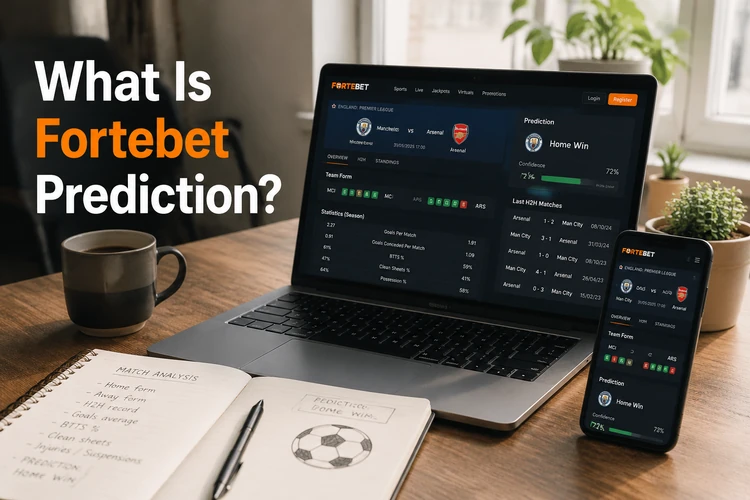
Predictions are guidance, not instructions. They show where the probabilities sit on a given day; they do not decide what happens on the pitch. A team may deserve a higher chance to win and still lose because football contains enough randomness to punish careless assumptions.
Fortebet Predictions for Today
Fortebet predictions for today usually focus on leagues where team news and statistics are easy to verify. The closer the match gets, the more useful the update becomes, because a late injury or a change in the starting line-up can alter the reading of the game.

When you review daily football analysis, compare home and away records instead of looking only at the overall table. Some teams look strong in the league summary but lose much of that edge away from home. Recent form also matters, but use a short sample with care: the last five to eight matches often says more than a season average distorted by old results.
- Check whether the match follows a mid-week fixture, because travel and fatigue often reduce intensity.
- League position matters less when a team has already secured its objective or cannot change its status much.
- Derby matches and rivalry games often produce results that ignore normal form, so treat them with extra caution.
- Weather and pitch condition can slow the tempo, especially in lower-scoring leagues.
Motivation is another piece of the picture. A club chasing a title, a qualification spot, or survival may approach the same fixture very differently from a side that has little left to play for. That context can explain why a strong statistical team still underperforms on the day.
Fortebet Mathematical Prediction
Mathematical prediction uses probability models to turn match data into estimated outcomes. A simple version starts with scoring rates: how often a team scores, how often it concedes, and how those numbers change at home or away. From there, the model can estimate win, draw, and loss chances.
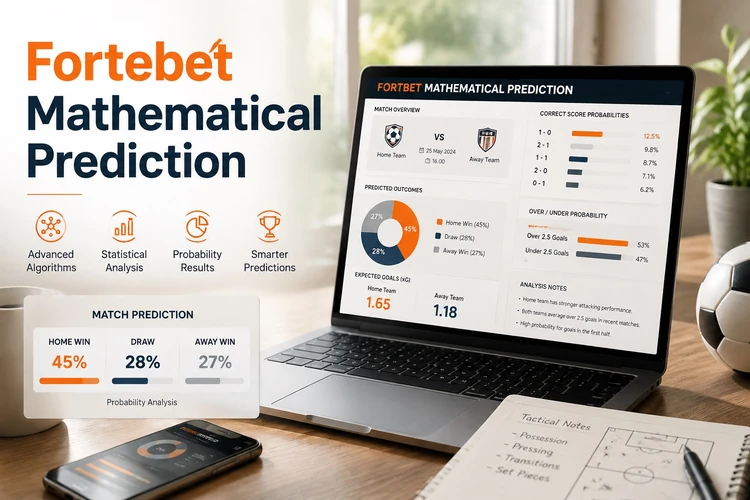
Expected goals, usually shortened to xG, refines the picture by judging chance quality rather than only final scores. A team may create many low-quality shots and still fail to threaten much, while another side can lose despite generating stronger chances. That is why xG is useful for spotting whether results are supported by the performance behind them.
More advanced ratings, such as Elo-style systems or models that weigh recent games more heavily, update team strength after each result. These tools can improve a preview, but they still cannot absorb every surprise: a red card, bad weather, or a goalkeeper problem can change a match in minutes.
Fortebet Betting Tips
Good Fortebet betting tips are less about chasing exact scores and more about finding value in the odds. Value appears when the price offered by the market implies a lower chance than your own analysis suggests. If your reading says a home win is more likely than the odds imply, that may be worth attention, even though it is never a sure thing.
Market selection matters too. The match result market is easy to understand, but it is not always the most efficient place to look. Asian handicaps, both teams to score, and over/under lines can give a clearer angle when the main result is tight. Beginners usually do better by learning one market properly before moving on to several at once.
Bankroll management sits underneath every decision. A simple approach is to risk a small fixed share of your betting budget on each wager, often 1% to 3%. That keeps a bad run from doing lasting damage and helps you stay calm when results swing against you. Flat staking is usually easier to control than changing stake size after every result.
Football Match Analysis
Strong analysis brings together several layers of information. Squad news is the most time-sensitive part, because one missing striker or central defender can change both attacking and defensive balance. Calendar congestion matters too, especially when a team has played mid-week and must travel again soon after.
Set-piece strength matters as well, because some teams create a large share of their chances from corners and free kicks. That can make a side look stronger than the open-play numbers suggest, or weaker if they depend on a single specialist who is unavailable.
| Factor | Why it matters | Where to check it |
|---|---|---|
| Recent form | Shows how the team is performing now | Recent results and match reports |
| Home and away record | Many teams play very differently by venue | Season split statistics |
| xG difference | Shows whether results match performance | Statistical databases |
| Injuries and suspensions | Affects selection and tactical balance | Club updates and team news |
| Fixture congestion | Fatigue can raise error rates | Competition calendar |
Head-to-head records can help, but only as support. They matter more in rivalries or domestic cups where the context repeats often. They matter less when the squads have changed a lot, or when the previous meetings came under very different conditions.
Common Mistakes When Using Predictions
The most frequent error beginners make is treating a prediction as a guarantee. A forecast with a 70% win probability will still be wrong three times in ten - and those losses often cluster, creating the impression that the analysis was flawed when in fact it was statistically reasonable. Accepting variance is a skill, and it takes time to develop.
Emotional betting - chasing losses after a bad session, or doubling stakes on a team you support - is where bankrolls collapse fastest. The data does not care which club you follow. Separating personal loyalty from analytical judgment is genuinely difficult, which is why many experienced bettors avoid wagering on their own team altogether.
Another common mistake is overreacting to a single good or bad result. One strong win does not make a team dominant, and one poor performance does not mean the model failed. Trends become clearer when you compare several matches, not one headline scoreline.
Responsible Betting
Predictions and tips are analytical information - they are not a path to consistent profit, and they carry no financial guarantee. Betting should be treated as entertainment, funded only by money you can afford to lose without affecting daily life. Responsible gambling means setting a budget before you start, sticking to it when results move against you, and taking breaks when the activity stops being enjoyable.
If you notice that you are chasing losses, increasing stakes too quickly, or feeling anxious about the next result, step back. Lower the stake, pause for the day, or stop entirely if the pressure is building. The point is to keep football fun and manageable, not to treat every match as a financial test. 18+
You can log in to your account to review current markets.
The mobile app page is useful if you prefer to check fixtures from your phone.
Used well, Fortebet prediction is a guide for reading matches, not a shortcut that removes uncertainty. The more you combine statistics, context, and discipline, the more useful it becomes.
FAQ
A Fortebet prediction is an analytical assessment of a football match outcome based on data such as team form, head-to-head records, squad availability, and statistical models. It is a guide, not a guarantee.
Predictions are built by combining quantitative data such as goals scored and conceded, home and away splits, and xG figures with context like injuries, suspensions, and match importance. The aim is to estimate the probability of each outcome.
Expected goals measures the quality of each shot in a match based on factors like distance, angle, and the type of chance created. It helps show whether a team’s results match the chances it is creating.
No. Even a strong prediction can be wrong because football is unpredictable and variance is part of the game. Any source that promises guaranteed wins is not being honest.
A simple method is to set a fixed budget and stake only a small share on each bet, often around 1% to 3%. That makes losing runs easier to absorb and keeps betting more sustainable.
Yes, but only as a starting point. Live betting moves quickly, so the pre-match read has to be adjusted for what is happening on the pitch, including injuries, tempo changes, and momentum shifts.